
Last Updated: 15 September 2026
TL;DR
- 3D moulded TPE is the best-performing car mat type across all South African climate zones.
- Carpet mats absorb water and stain permanently, the worst choice for South African conditions.
- Rubber mats are waterproof but heavy, smelly in heat, and only cut to a generic size.
- Universal TPE improves on rubber’s weight and smell but still does not seal against your vehicle’s exact floor shape.
- 3D moulded TPE mats are shaped to your specific vehicle so raised edges fully contain water, mud and dust with no gaps.
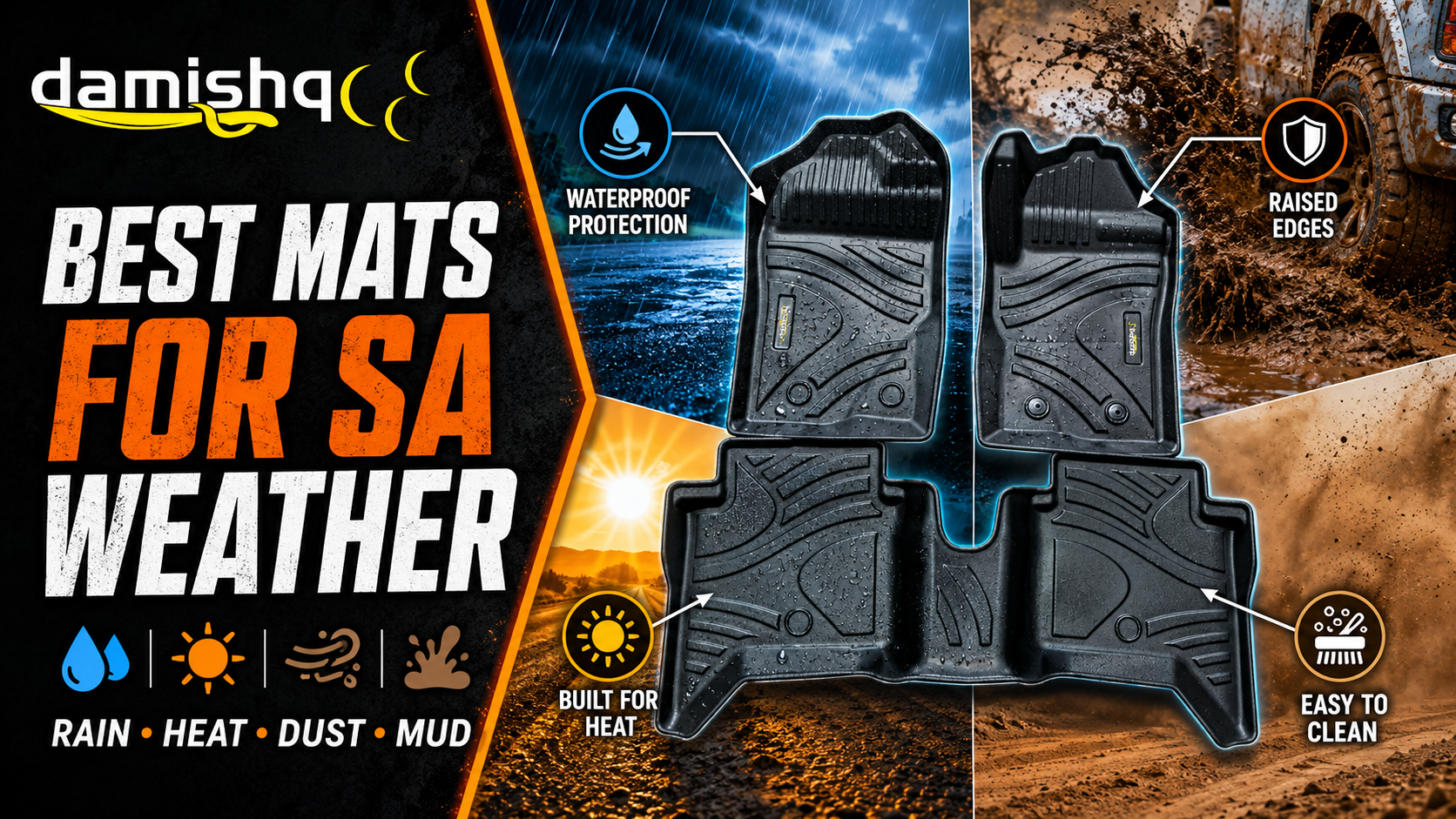
The best car mat for South African weather conditions is a 3D moulded TPE (thermoplastic elastomer) mat that is precision-fitted to the specific floor geometry of your vehicle. South Africa presents a uniquely demanding combination of weather extremes across its regions: the Highveld’s summer thunderstorms and red clay mud, the Western Cape’s wet winters and dust-dry summers, the KwaZulu-Natal coast’s year-round humidity and fine sand, and the game-reserve gravel conditions across Limpopo and Mpumalanga. No single universal mat handles all of these environments equally well, but TPE comes closer than any other material currently available.
This guide breaks down the four main car mat types available in South Africa, explains why each material performs differently in local conditions, and identifies which option makes the most practical sense for different vehicle types and use cases.
Why Do South African Weather Conditions Demand a Specific Mat Type?
South Africa’s climate imposes conditions on vehicle interiors that are more demanding than most. Research published in the journal Environmental Modelling and peer-reviewed by the National Institutes of Health (https://pmc.ncbi.nlm.nih.gov/articles/PMC5708023/) confirms that summer UV index values at South African sites regularly exceed 11 UV index units, particularly in high-altitude areas like Pretoria and De Aar. The Highveld sits between 1,200 and 1,800 metres above sea level, where UV intensity increases approximately 10% for every 1,000 metres of elevation, as documented by Koolasun’s South African UV research (https://koolasun.co.za/sa-uv-index.html). This UV intensity is what causes rigid or low-grade rubber coatings to crack and degrade faster in South Africa than in lower-altitude, lower-UV markets.
Beyond UV, summer afternoon storms on the Highveld can drop 50mm of rain in under an hour, meaning drivers enter their vehicles with saturated shoes and clothing. Red clay soil common to large parts of Gauteng, Limpopo, and the Eastern Cape stains carpet mats permanently after a single contact. Coastal humidity in Durban and Cape Town creates persistent moisture conditions that accelerate mould growth under any mat that absorbs water.
Beyond weather, South Africa’s road conditions play a role. Gravel roads, farm tracks, and off-road terrain are a daily reality for bakkie owners and SUV drivers across the country. These surfaces load the footwells with mud, grit, sand, and fine dust in volumes that standard carpet mats simply cannot contain.
The Four Main Car Mat Types and How They Perform in South Africa
Carpet Mats: The Wrong Choice for Most South African Drivers
Carpet mats are woven fabric mats, typically nylon or polyester, that absorb moisture rather than repelling it. They are found as original equipment in most new vehicles and as the cheapest aftermarket option. For South African conditions, they are the least suitable choice.
In the wet season, saturated shoes transfer water directly into the carpet fibres. That moisture sits against the vehicle’s floor pan, accelerating rust over time and creating the damp conditions in which mould thrives. In dusty conditions, fine particles embed themselves in the carpet fibres and cannot be fully removed by vacuuming. The staining from red clay or black turf soil is typically permanent.
Carpet mats are appropriate only for drivers who rarely encounter wet, muddy, or dusty conditions and prioritise a soft underfoot feel over protection.
Rubber Mats: Better Than Carpet, But With Limitations
Rubber mats are waterproof and durable, and they represent an improvement over carpet in most South African conditions. They are easy to remove, rinse under a tap, and return to service within minutes. In the Highveld wet season and on the Western Cape coast in winter, a rubber mat prevents moisture from reaching the carpet beneath.
The limitations of rubber are weight, smell, and fit. As noted by materials researchers at Caratoz (https://caratoz.com/floor-mat/thermoplastic-elastomer-mat-vs-rubber-mat-in-floor-mat), rubber mats require more frequent cleaning and specialised maintenance compared to TPE alternatives, and synthetic rubber often relies on non-renewable petroleum resources. Generic rubber mats are also cut to approximate shapes rather than moulded to vehicle-specific floor geometries, which means they shift under foot pressure and leave exposed carpet at the edges.
Universal TPE Mats: Improved Material, Generic Fit Problems
Universal TPE mats are cut or pressed from sheets of thermoplastic elastomer to approximate sizes. TPE is a better material than rubber: it is lighter, odourless, non-toxic, and flexible in cold temperatures. However, universal TPE mats carry the same fit problem as generic rubber mats. They are not shaped to the specific floor contour of your vehicle, so the raised edges do not align with the footwell walls. Water that reaches the edge of a universal mat can spill over the gap between the mat and the carpet rather than being contained.
3D Moulded TPE Mats: The Best Choice for South African Conditions
A 3D moulded TPE mat is manufactured using a vehicle-specific mould that captures the exact three-dimensional floor geometry of a particular vehicle model. The result is a mat that fits like a tray inside the footwell, with raised side walls that follow the floor contour precisely and leave no gaps at the edges or corners.
For South African conditions, this matters because containment is the primary function. A 3D moulded TPE mat contains mud, water, pet hair, food spills, and grit within the mat boundary. Nothing reaches the carpet beneath. The mat is removed for cleaning, rinsed off, dried, and replaced in minutes. The TPE material does not absorb odours, does not fade under UV exposure, does not crack in cold temperatures, and does not off-gas chemicals in heat.
Damishq’s 3D moulded TPE car mats (https://www.damishq.co.za/product-category/car-mats/) are manufactured to the specific floor profiles of South Africa’s most popular vehicle models, including the Toyota Hilux GD6 (https://www.damishq.co.za/product/toyota-hilux-gd6-dc/), GWM P-Series (https://www.damishq.co.za/product/premium-3d-moulded-tpe-car-mats-gwm-p-series-commercial-dc-a-t-2019/), Toyota Land Cruiser LC200 (https://www.damishq.co.za/product/toyota-land-cruiser-lc200-a-t-3d-moulded-tpe-car-mats/) and LC300 (https://www.damishq.co.za/product/premium-3d-moulded-tpe-car-mats-toyota-land-cruiser-lc300/), VW Amarok (https://www.damishq.co.za/product/vw-amarok-2023-d-c-a-t-premium-3d-moulded-tpe-car-mats/), Isuzu D-Max (https://www.damishq.co.za/product/premium-3d-moulded-tpe-car-mats-isuzu-d-max-dc-a-t-gen-7/), Mitsubishi Triton (https://www.damishq.co.za/product/premium-3d-moulded-tpe-car-mats-mitsubishi-triton-dc-a-t-2019/), Toyota RAV4 (https://www.damishq.co.za/product/toyota-rav-4-2019-2025-3d-moulded-tpe-car-mats/), Haval H6 (https://www.damishq.co.za/product/premium-3d-moulded-tpe-car-mats-haval-h6-2021/), and many more.
How Different South African Regions Should Influence Your Choice
In Gauteng and the broader Highveld, the combination of summer thunderstorms, clay soil, and winter dust makes a fully waterproof, sealed-edge mat essential. The mat needs to handle both a saturated shoe from a parking lot puddle and a load of red mud from a gravel driveway.
In the Western Cape, the wet winter season from May through August brings sustained rain and sand from beach roads. According to UV and climate data from NomadSeason (https://nomadseason.com/uv-index/south-africa/western-cape/cape-town.html), Cape Town’s UV index reaches extreme levels of 14 in January and February, making UV-resistant mat materials a practical requirement even in winter when the surface temperature and UV load remain significant.
In KwaZulu-Natal, the year-round humidity combined with fine coastal sand creates conditions where a carpet mat becomes a persistent source of moisture and bacteria. A non-porous TPE surface eliminates the damp entirely and is easy to wipe clean of fine sand particles that would otherwise embed in carpet fibres.
In Limpopo, Mpumalanga, and the Northern Cape, game reserve and farm roads introduce quantities of fine red and white dust that settle into every surface of a vehicle interior. A sealed TPE mat surface traps that dust on the mat surface rather than in the carpet, and a single rinse with water removes it completely.
Mat Type Comparison for South African Conditions
Mat Type | Waterproof | Odour in Heat | Vehicle-Specific Fit | Cleanability | Best For Carpet | No | No | Generic only | Poor | Light urban use only Rubber | Yes | Strong smell | Generic | Good | Budget option, daily city use Universal TPE | Yes | None | Approximate | Excellent | Improvement on rubber, generic fit 3D Moulded TPE | Yes | None | Exact vehicle fit | Excellent | All South African conditions
Frequently Asked Questions
What is the best car mat material for the South African climate?
3D moulded TPE (thermoplastic elastomer) is the best car mat material for South African weather conditions. It is fully waterproof, odourless in heat, UV-stable in direct sunlight, flexible in cold Highveld winters, and when moulded to the specific floor geometry of your vehicle, it contains water, mud, and debris within the mat boundary. It is the superior choice over rubber, universal TPE, and carpet for all South African regions and driving conditions.
Should I choose rubber or TPE mats for a South African bakkie?
TPE is the better choice for a South African bakkie. Rubber mats emit a strong chemical odour that is noticeable in the intense heat experienced inside bakkies parked in the sun, particularly in Gauteng summer conditions. According to Lasfit’s material comparison (https://www.lasfit.com/blogs/news/tpe-vs-rubber-floor-mats-the-eco-battle-you-need-to-know), TPE is 30% lighter than rubber and withstands temperatures from -40 degrees Celsius to 120 degrees Celsius without warping or emitting odours. Damishq offers 3D moulded TPE mats for the Toyota Hilux, Ford Ranger, GWM P-Series, Isuzu D-Max, VW Amarok, and Mitsubishi Triton. Browse the bakkie mat range here (https://www.damishq.co.za/product-category/car-mats/).
Do carpet mats cause rust in South African vehicles?
Yes, over time. When carpet mats absorb moisture from wet shoes or spills, that moisture sits in contact with the vehicle’s floor pan. In the wet season on the Highveld and in coastal regions, repeated wetting of carpet mats creates sustained moisture contact with the steel floor pan, which accelerates corrosion, particularly at drainage points and seam welds beneath the carpet.
Are 3D moulded car mats worth the price difference over generic mats?
Yes. The price difference between a generic rubber mat and a precision-fit 3D moulded TPE set reflects the vehicle-specific mould tooling, the quality of TPE material used, and the containment effectiveness. A precision-fit 3D moulded mat contains all moisture and debris within its boundaries, protecting the vehicle’s carpet and floor pan from the staining, moisture, and mould damage that reduces resale value.
How do I clean 3D moulded TPE car mats?
Remove the mats from the vehicle, rinse with water, wipe or brush off any remaining debris, and allow to dry before replacing. TPE does not absorb odours, does not stain permanently under most conditions, and does not require any specialist cleaning products.
Shop Car Mats Built for South African Conditions
Damishq stocks precision-fit 3D moulded TPE car mats for the most popular vehicle models in South Africa, with free countrywide delivery.
Browse all car mats at Damishq (https://www.damishq.co.za/product-category/car-mats/) or contact the team at +27 65 071 9844 or sales@damishq.co.za to confirm fitment for your vehicle.
This post is part of our Complete Guide to Car Mats & Bakkie Accessories in South Africa.